Every customer calls in about price. Your team decides where the call goes from there.
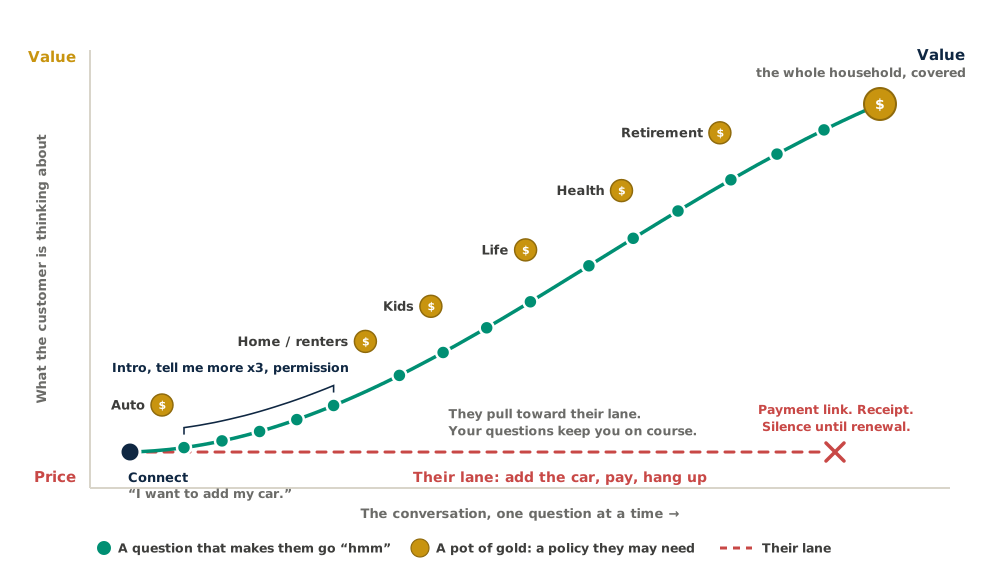
Left alone, a customer rides their own lane: add the car, pay, hang up. Every question your producer asks moves them up and to the right, toward the whole household.
Bottom left: priceThey come in thinking about the number. “I want to add my car.”
Every dot is a questionIntro, tell me more three times, then permission. Each one moves them up and to the right.
Top right: valuePots of gold light up along the way. You don't know which one is next until you ask.
!
Why you careMost calls in most offices end on the customer's lane: a payment link, then silence until renewal. Nothing in this system asks your team to sell harder. It asks them to ask the next question.
Stop 2 of 6 · The whole system on one screen
Five steps. Every policy. One screen.
Every policy runs the same five steps, from Connect to Advocate. Auto takes the least trust, so it sits at the bottom. Each policy up the ladder needs more. Click any orb.
Policy
Connect
Like
Trust
Buy
Advocate
RetirementNobody requires it. Earned last.
HealthNobody requires it
LifeNobody requires it
Home & rentersThe lender requires it
AutoThe state requires it
AutoConnect
Handle the car, and start a relationship while you do it.
“What’s got you on the phone with me today?”
A preview. Your producers' Map opens every orb: what to say, what to listen for, and where to go deeper.
Why the rows climb
It isn't talent and it isn't effort. It's how much trust each policy needs, and how little a quick, number-first call builds.
Autothe state requires it
Homethe lender requires it
Lifenobody requires it
Healthnobody requires it
Retirementnobody requires it
Trust the policy needsTrust a number-first call buildsThe gap: policies your team never gets to present
!
Why you careThat gap is why an office can write hundreds of policies a year and only a handful of them are life. Your producers aren't bad at life. They never earn the conversation. The Map spreads that trust across short calls, one orb at a time.
One better question, before they ask for anything.
Your producers still take care of what the customer called about. Then, instead of pitching, they ask a question that makes the customer stop and think.
How most calls goHow this system runs it
“Do you have life through work?”“Yep.”Conversation over
→
“When's the last time you looked at what the coverage through your job actually pays?”“…Honestly? The day I was hired.”Now it's a conversation
Every first call runs four moves, in this order
Win itSolve what they called about, and say “that part's done.”
Make them go “hmm”Two or three open questions about their life, not their policy.
Ask permissionAsk for fifteen minutes, not a sale.
Book it & lock itA day and a time, written down, before they hang up.
What it sounds like
A service-desk call: a client phones in to add a car. Watch how the producer finishes the job first, earns the right to ask, and only then asks.
Producer · Win it“Alright, the new SUV is on your policy as of today, and your ID cards are on their way to your email. That part's done. Anything else on the car?”
Customer“Nope, that's it. We needed something bigger before the baby gets here.”
Producer · Set it up“Congratulations, that's a big year. While I have you, can I ask you something that has nothing to do with the car?”
Customer“Sure, go ahead.”
Producer · Make them go “hmm”“With the baby coming, if one of your paychecks stopped for a few months, say you got hurt, what would happen with the house payment?”
Customer“Hmm. Honestly, I don't know. We've never really talked about that.”
Producer · Ask permission“That's normal. Most families haven't. And a year like this usually opens up a few gaps at once: your income, the house, what the coverage through work really pays, even the limits on the new car. I'd hate for you to find any of them out the hard way. Would it be worth fifteen minutes to look at the whole picture together, and see where you're covered and where you're not? No cost, and you decide what, if anything, to do about it.”
Customer“Yeah, that makes sense.”
Producer · Book it & lock it“Great. I have Thursday at 2 or Friday at 10. Which is better? And if your partner can join, even better, since it's both paychecks. I'll text you a reminder the day before.”
!
Why you careNobody has to become a “life person.” Your auto and home producers run the same four moves on the calls they already take, from the sales desk or the service desk.
Open the First Call guideThe full guide your producers use: the questions, the cues to listen for, and how to book the next call.
Stop 4 of 6 · What the client sees
The Gap Audit: the fifteen minutes that open life.
The first call books it. The Gap Audit is the second call: no numbers, no pitch. Your producer asks, the household talks, and together they find where the family is exposed.
Call 1
Win the call
Solve what they came for. Ask the “hmm” question. Book fifteen minutes.
Call 2 · This stop
The Gap Audit
Ask, don't pitch. The household says what matters most to them.
Call 3
Show the options
“Here's what I found.” Good, Better, Best. They choose.
What your producer hands the client
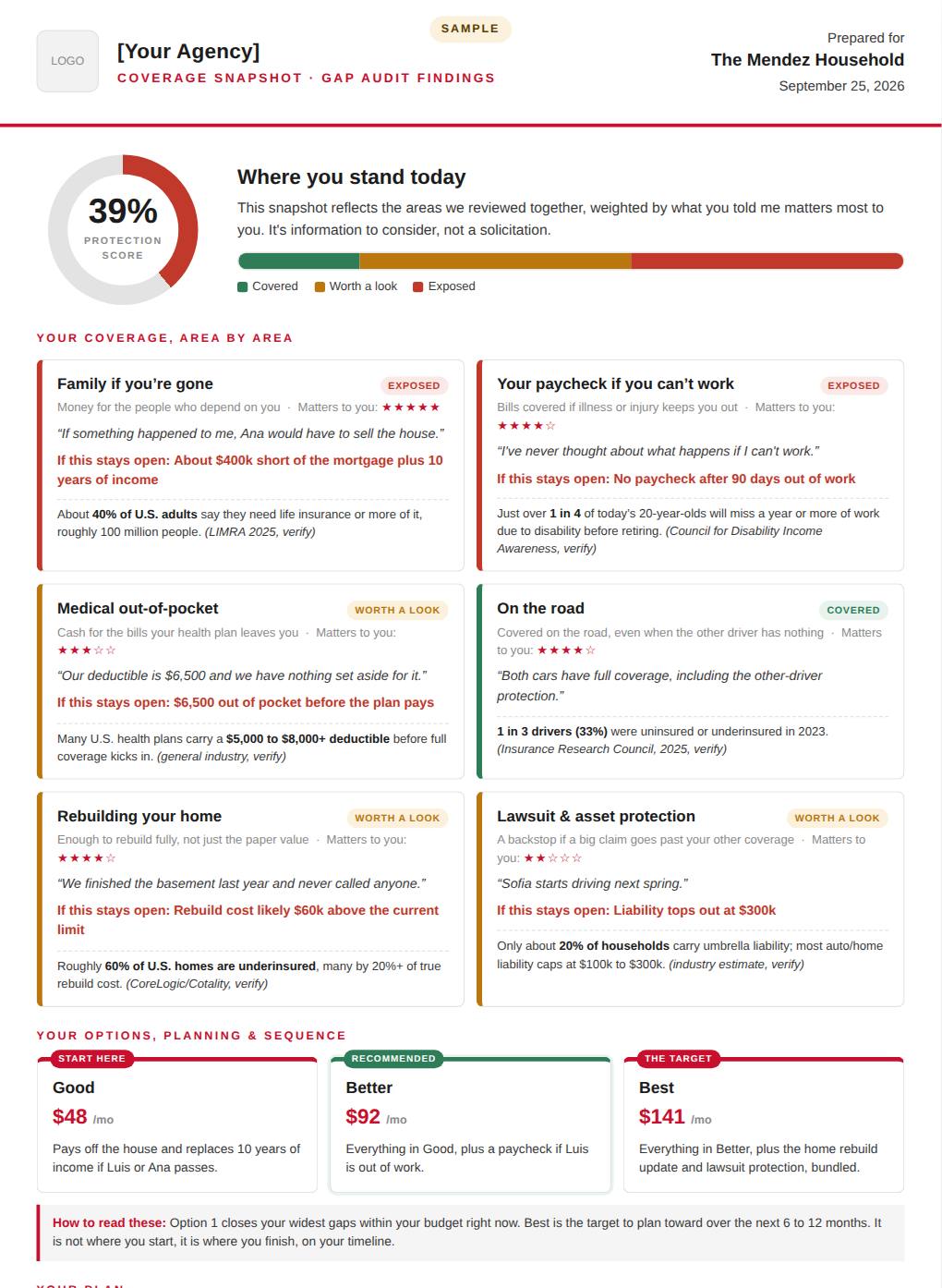
After the Gap Audit, the producer fills in the Gap Audit PDF Generator. It turns the conversation into a one-page coverage snapshot, in the client's own words, that the client keeps. Before any client sees it, your agency signs off on the layout and wording, the same way you'd approve any client-facing material.
A sample household. Every area shows the client's own words, what's open, and why it matters. Then three options, widest gap first.
1
Six areas, in plain words“Family if you're gone,” “Your paycheck if you can't work,” “Rebuilding your home.” No jargon.
2
Weighted by what they said mattersThe client scores each area 1 to 5 for how much it matters, so the score reflects their priorities, not the producer's.
3
Good, Better, Best, with a planStart with the widest gap the budget allows. The rest becomes a plan with a date or an event to revisit it.
!
Why you careThis is where life comes up without anyone selling it. The household names the gap, sees it on paper, and chooses how to close it.
Score one real call a week. It tells you exactly what to drill.
Your manager plays back one recorded call and scores each beat 0, 1, or 2. The lowest scene is the one thing that producer practices this week. No guessing, no “close more.”
Call Audit · SampleCall 1 · Win the call · producer in week 3
Beat
Score
Scene 1 · Arrive
Match energyCalm, pulls the account up out loud
012
Give them the winSolves what they called about, completely
012
Scene 2 · Turn
Plant the gapOne calm sentence and a question, no selling
012
Scene 3 · Book Lowest scene
Book the auditFree, fifteen minutes, a day and a time
012
Catch the soft noOne calm turn instead of folding
012
The one broken sceneBook. Asked “would you like to set something up?” and got “I'll call you.”
This week's drillAsk when, not whether. “What does Thursday at 2 look like?” Ten reps in the practice block.
A sample. The full sheet covers all three calls in 18 beats, plus two compliance checks that stop the call review on their own.
3 × 30minutes a week of practice, run by your manager, logged so you can see who's doing it.
!
Why you careTraining fades in three weeks. A weekly score on a real call is how you know the habit is showing up, and your manager coaches a behavior instead of a mood.
You don't roll out the whole playbook at once. Each phase installs one behavior, and the team doesn't move on until it shows up without anyone asking.
Weeks 1–3
Open cleanA calm start, a real question, and a what-if before any number.
Weeks 4–6
Book the Gap AuditThe Gap Audit gets invited, and the next call is on the calendar before they hang up.
Weeks 7–9
Sales and service as one teamThe service desk solves first, then plants the Gap Audit on the calls it already takes.
Weeks 10–12
Your manager owns itThe coach steps out. Your manager runs the drill and the call review without anyone in the room.
Who does what
You, the owner
Protect the standard. Review the numbers weekly. Show up to every leadership meeting.
Your manager
Five minutes a day on the scorecard. One call review per producer a week.
Your producers
Run the four moves on every call. Improve one scene a week.
That's the whole system.
The conversation that opens life, the Gap Audit that shows the household what's open, the weekly score that tells you it's working, and a rollout your manager can run without you.
It comes with coaching from Jeremy, and it starts with a 30-minute call.