It isn't talent, and it isn't effort. It's the first call. Conversation to Coverage gives your producers the questions that make customers stop and think, a fifteen-minute Gap Audit that opens up the rest of the household, and a weekly practice rhythm your manager runs without you.
Everyone else writes the auto and moves on to the next call.
Then weeks of chasing someone who won't open the email.
Everyone nods in the meeting, then goes right back to the old habit on the next call.
Auto is required by the state. Home is required by the lender. Life, health, and retirement are required by nobody. Only trust sells them, and a quick, number-first call never builds enough of it.
That gap is why an office can write hundreds of policies a year and only a handful of them are life. And two habits make it wider on almost every call:
You're the lowest number about 3 or 4 times in 10. The moment your team says “quote,” the customer hears “price,” and you've signed up for the one fight you lose most of the time.
Record your best producer's call and count the sentences. They're probably doing most of the talking. The customer should be.
You can't build the trust life, health, and retirement need in one call, so the system stops trying. Each call earns the next.
Take care of what they came for. Ask the questions that make them think. Book fifteen minutes.
Fifteen minutes, no numbers, no pitch. Ask, listen, and find where the household is exposed.
“Here's what I found.” Good, Better, Best, widest gap first. They choose.
This is where the whole system is won or lost, so it's where your team starts.
Solve what they called about, completely. Say out loud that it's done.
Two or three open questions about their life, not their policy.
Ask for fifteen minutes, not a sale. Let it be their idea.
A day, a time, what to bring, written down. Confirmed the day before and the hour before.
The one test for every call: did a question make them go “hmm” before you asked for anything?
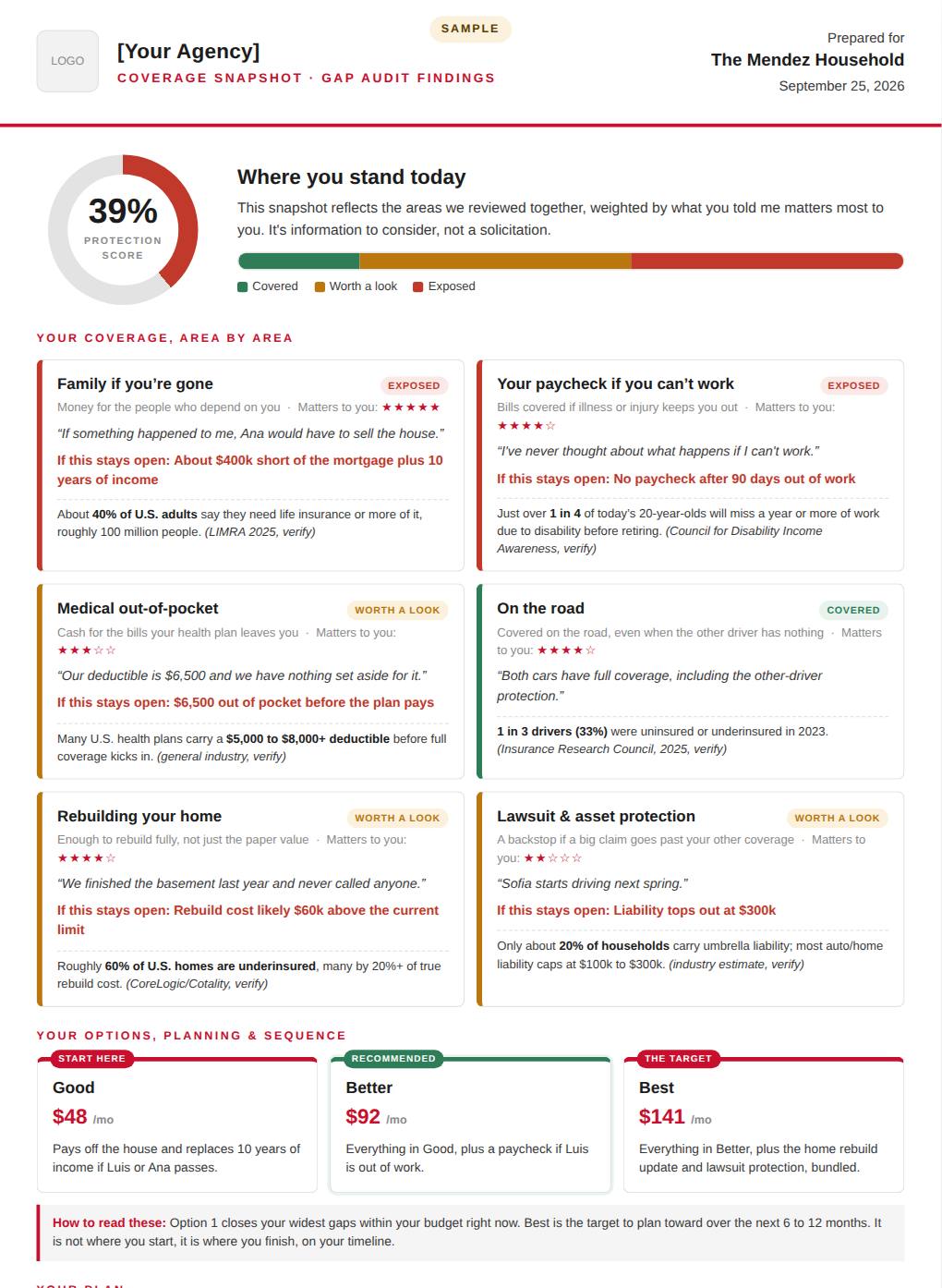
The first call books it. The Gap Audit is a no-numbers, no-pitch conversation: your producer asks, the household talks, and together they find where the family is exposed. Then the client gets it on one page.
Every agency has been trained. Most of it's gone in three weeks, because knowing the words isn't the same as saying them on a live call. This system comes with the practice built in, and a way to see that it's working.
Your manager plays back one recorded call and scores each beat 0, 1, or 2. The lowest scene is the one thing that producer practices this week. No guessing, no “close more.”
Set it to your agency. This is an illustration, not a promise, but it shows why the conversation is the one thing worth fixing.
Illustrative only. Actual results depend on your book, your team, your carrier, and how consistently your team practices.
Every word track was rehearsed, used on real calls, and rebuilt from what happened, inside a working agency with a producer on the phone every week. Here's what that's produced so far.
Up every month, with more Gap Audits booked and deeper conversations on every call.
Figures reflect the current pilot. Production results depend on the office, the book, and consistent practice. Any dollar figures inside the playbook are training examples until confirmed against current carrier numbers.
"I watched one of my producers go from zero life apps to five in a single month. She wasn't working harder, she'd finally found a way to have the conversation. This gave my whole office that same way, on purpose instead of by luck."
"What I trust is the diagnosis. It doesn't just say 'sell more life,' it shows me the exact scene where a call broke and the one drill to fix it that week. That's the difference between a pep talk and a system that actually sticks."
"I used to freeze the second a call turned toward life. Now the Gap Audit carries it for me. I ask the questions, the household opens up, and I never feel like I'm selling. It stopped being the scary part of my day."
Most training programs hand your team short videos and word-for-word scripts. Everyone watches, everyone nods, and the next call sounds exactly like the last one. Knowing the words isn't the same as saying them on a live call. And a script that tries to get everything done in one call is exactly why customers freeze up.
| A video-and-script library | Conversation to Coverage | |
|---|---|---|
| How it's learned | Short videos, watched once. | Practiced three times a week, one skill at a time, and logged. |
| The first call | A script that pushes every call from the number to four lines of coverage in one sitting. | Win the call, make them go “hmm,” book the next conversation. Life comes up on call three, once the trust is there. |
| The words | “Let me get you a quote.” | Human language that keeps the conversation off price: “the numbers you asked for.” |
| Your two desks | One script for everyone. | Separate tracks for the sales desk and the service desk. |
| When it slips | A scoreboard shows it, after the numbers drop. | A weekly practice log shows it first, while it's still easy to fix. |
A playbook on a shelf changes nothing. Jeremy Kean coaches the owner and the manager who run it, until the system is simply how your agency sells. The only question is how much coaching your team needs.
A sales process only holds when the agency behind it does. So your coaching doesn't stop at the phone call.
See everything Kean on Biz works onNo price list and no pitch on the first call. Three short conversations, and each one earns the next.
Tell Jeremy what's happening on your team's calls. If it isn't a fit, you'll hear that on the call.
Your numbers, your team, and one recorded call. You leave knowing what you do well, what you don't do yet, and what we'd suggest.
Three ways to close the gap we found, built for your agency, with the investment for each. You choose.
It depends on your team and how much coaching you want, so we don't guess before we've seen your agency. On the Agency Gap Audit we find the gap first. Then you get three options, each with its price, and you choose.
Yes, in every option. The difference is how much: monthly group coaching, weekly one-on-one coaching for your manager, or Jeremy working with your whole team.
Jeremy Kean and Kean on Biz. We coach insurance agency owners on the whole agency: structure, leadership, follow-up, and sales. Conversation to Coverage is the sales piece. See all of it.
Keep it. Most systems hand your team the right questions but not the setup that makes them land, so they come out sounding like a form. This adds the two or three setup questions in front, and the order to ask them in.
Training isn't practice. This comes with the practice built in: a 30-minute block three times a week, one skill at a time, and a log your manager checks. That's the part every other program skips.
It's built on questions, not scripts. Your people keep their own voice. The system tells them what to ask, and when.
Everyone who talks to a customer. Owners get a team that runs the same conversation whether they're in the room or not. The sales desk gets the questions and the order to cross from auto into life, health, and retirement without sounding salesy. The service desk turns the calls it already takes into booked reviews, because your book is the warmest lead source you have.
Yes. Same four moves. Service starts further along because the client already trusts you, and every payment, change, or renewal is a natural opening.
When the first call makes them think, most say yes to fifteen minutes. The system includes the confirm rhythm that gets them to actually show up.
The 90-day rollout installs one habit at a time. How fast it shows up in production depends on how consistently your team practices. That part is on purpose.
No. Everything your manager needs is laid out: what to practice, when, and what good looks like. You protect the time; they run the block.
One skill, practiced until it's habit, on every call, from both desks. It starts with a 30-minute call.